



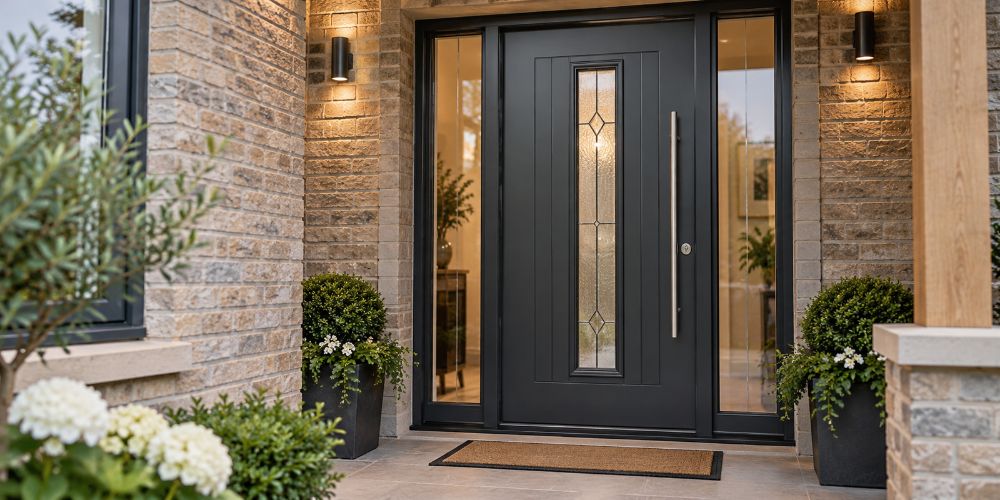
Where there isn’t much timber on the surface, a front door might take on the appearance of painted wood. The grain seems genuine, the color is recognized and the door slams with a loud boom. But what was within the construction might be quite different from the original wooden door it replaced.
That’s what a composite door is for. It’s not one item that does the job, it’s a variety of materials that execute the duty. Horizon Windows offers a selection of entrance types, including insulated units in various wall thicknesses. If you know what is behind the finish, it is easier to grasp the distinctions.
What Is A Composite Door?
Most composite doors have a protective outer skin, a structural framework and core. Each manufacturer has a somewhat different composition. Many are constructed with mostly high density insulating foam. Others will use solid wood pieces or manufactured wood in between.
This is more than a plastic gate. The strengthening and the manner the parts are joined keeps it stable when the temperature changes, the edges. A heavier door isn’t automatically a better door either. The weight alone is no guide to the sealing of the frame or the engagement of the lock.
The simplest way to understand the structure is to examine each layer individually. A product cross section is so much more than a tap on the surface.
The Hard Skin on the Outside
Many composite front doors are manufactured from glass reinforced plastic, frequently abbreviated to GRP. The outside surface is strong without the weight of a thick sheet of metal, due to the resin composition reinforced with fine glass fibers. The skin can be shaped with raised panels or wood grain design.
Its main job is to take the daily battering of rain, wind and knocks. GRP does not need frequent staining to protect against water as does bare wood. It still needs cleaning. Don’t overlook a badly damaged cover or edge.
Sunlight counts too. Dark surfaces, particularly on a south facing door, can heat up considerably. Horizon explains why composite doors are prone to warping, how the shape can be affected by uneven heat and poor fitting. It is true that a tough outer covering makes movement less probable but not impossible.
Behind The Scenes Wood & Foam
Polyurethane foam is the most frequent core material. It occupies the area in the door and reduces heat transmission. Horizon Windows has a choice of 44mm single rebate and 70mm double rebate composite designs with substantial polyurethane insulation.
Not all brands employ a foam centered structure. Some doors feature a solid wooden core, which is often made from engineered lumber. These models rely heavily on the wood frame for their stiffness. The finish/insulation details are still different.
This difference explains why general descriptions might be deceptive. Two composite labeled goods might have substantially different cross sections. Another approach to discover how the structures vary is our guide comparing uPVC and composite door material.
Rather than assuming every composite model has the same layers, a buyer should verify the specified core material. It’s important to investigate whether a specified thickness applies to the full door leaf or only a section of its construction.
Security Hardware, Seals and Frames
The slab receives most of the attention, but it doesn’t operate in isolation. A door requires also a well fitting frame, hinges and locking points. Reinforced uPVC frames are used in certain systems. Others employ other structural configurations depending on the maker.
Multi point locks have more than one point of engagement along the strike edge. They rely on the whole door assembly, including the frame and the quality of installation. A strong foundation can’t make up for weak hinges or misaligned keeps.
Rubber or flexible weather seals are used to assist block drafts at the edges. The double rebate designs provide a second sealing channel when the door closes. That detail might be more important than the thickness you see in a brochure on a windy evening.
What About Decorative Panels and Glass?
A glazed composite door brings additional material into the mix. Designed opening with suitable glazing components are generally the way decorative glass is fitted. Some of the models are double or triple glazed.
The glass must have appropriate safety glazing and adequately sealed. A badly installed glazing unit may be a source of draughts or moisture even with a highly insulated door.
Woodgrain moldings, letter boxes and metal handles also alter the final specification. Their status is not simply window dressing. If the design allows, cutting a letterbox into a completed slab might upset reinforcement or weaken the seal.
Are The Materials A Better Door?
Composite structure offers a realistic compromise between insulation, weather resistance and attractiveness. It also explains why you don’t need to maintain a real hardwood surface for an authentic wood look.
But a list of materials doesn’t show overall quality. The thermal rating is for the tested assembly, not the foam alone. The lock, frame and related tests determine security performance. A door that scrapes on its threshold every winter has an installation fault, no matter what fills its core.
That’s why when evaluating front doors in Dublin it’s about looking at the whole specification, not just an image of the finish. Good fit and right measurements from day 1 is important. Even excellent weather seals will have problems if a door is hung out of square.
Conclusion
So, what are composite doors made from? Usually a combination of protective skins, insulation and structural materials, supported by locks and seals. The recipe changes between manufacturers. When considering composite doors, the useful checks are the actual core, glazing, frame and installation details. Those determine much more than the wood effect on the outside.