


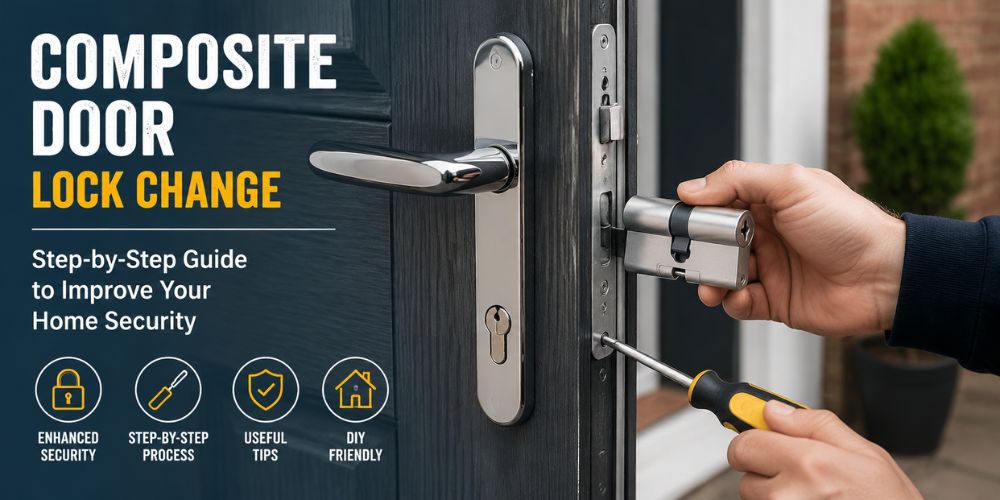
To change a lock on a composite door, you need to remove the existing cylinder from the multipoint locking system, replace it with a correctly sized high-security cylinder, and test the mechanism to ensure the hooks, rollers, and bolts engage properly. The lock cylinder can usually be replaced without removing the entire locking strip or door hardware.
Step 1: Identify the Correct Replacement Cylinder
Before removing the lock, identify the type and size of cylinder fitted in your composite door.
Most composite doors use a Euro profile cylinder, available as:
- Double cylinder: Key operation from both sides
- Thumb-turn cylinder: Key outside and thumb-turn inside
- Single cylinder: Key operation from one side only
Measure the cylinder from the centre of the fixing screw hole to each end, not from one end of the cylinder to the other.
For example:
- 35/35mm cylinder = 35mm external side + 35mm internal side
- 40/50mm cylinder = 40mm external side + 50mm internal side
Euro cylinders are normally available in 5mm size increments, so accurate measurement prevents fitting a cylinder that is too short or unnecessarily exposed.
Important security detail:
The cylinder should sit almost flush with the handle backplate. Ideally, it should protrude only around 0–3mm. A cylinder sticking out significantly can become easier to attack.
Step 2: Open the Door and Locate the Cylinder Screw
Open the composite door fully and look at the edge of the door where the locking strip is located.
Find the long fixing screw positioned in line with the centre of the cylinder.
This screw holds the Euro cylinder inside the multipoint lock case.
Tools required:
- Phillips screwdriver
- Tape measure or vernier calliper
- Replacement Euro cylinder
- Key for the existing lock
Step 3: Remove the Existing Lock Cylinder
Follow this process:
- Remove the central cylinder retaining screw from the door edge.
- Insert the existing key into the cylinder.
- Turn the key slightly, usually around 10–15 degrees, until the internal cam aligns with the cylinder body.
- Pull the cylinder straight out from the door.
The cylinder will not slide out while the internal cam is blocking the opening. Small key movement aligns the cam so the cylinder can pass through the lock mechanism.
Step 4: Measure the Old Cylinder Correctly
Once removed, measure:
- Distance from the fixing screw centre to the outside face
- Distance from the fixing screw centre to the inside face
Example:
Existing cylinder:
- Outside: 45mm
- Inside: 55mm
Replacement required:
45/55 Euro cylinder
Do not replace it with a standard equal-size cylinder unless the measurements match. Composite doors often require offset cylinders because the lock position is not always centred within the door thickness.
Step 5: Install the New Cylinder
Insert the replacement cylinder into the lock opening.
Follow these steps:
- Insert the key and slightly rotate it to align the cam.
- Slide the cylinder into the door until it sits correctly inside the lock body.
- Align the fixing hole with the screw opening on the door edge.
- Reinstall the retaining screw.
- Tighten the screw firmly but do not overtighten.
Over-tightening can place pressure on the cylinder and make the key operation stiff.
Step 6: Test the Multipoint Locking System
Before closing the door, test the lock.
Check:
- The key turns smoothly
- The handle lifts normally
- Hook bolts extend fully
- Mushroom rollers engage correctly
- The door locks without forcing the handle
Composite doors rely on accurate alignment between the cylinder, gearbox, and locking points. If the key turns but the handle feels stiff, the issue may be with door alignment or the multipoint mechanism, not the new cylinder.
Step 7: Upgrade Security Features (Optional)
When replacing a composite door cylinder, consider upgrading to a higher-security model with:
- Anti-snap protection
- Anti-drill protection
- Anti-pick protection
- TS007 3-star security rating
The cylinder is often the weakest point of an entrance door, so upgrading it can significantly improve resistance against common lock attacks.